Q1 2027 • VOL. 8, NO. 1
WINTER / SPRING ISSUE
GRAVELCENTURY.COM/VOL2
2027 Engineering & Cultural Landmark
THE 32-INCH FRONTIER & THE GRAVEL TSUNAMI
From Girona's radical 32" prototypes to 48% of all centuries turning unpaved: How gargantuan wheels, $1.7B market expansion, and 8 brutal Q1 courses transformed cycling.
SEA OTTER DISPATCH
Avona Callis 32 UCI Victory, Megamo Silk 32 & ISO 686
THE GRAVEL BOOM
2.1M Bikes Produced & The Economics of Dirt Towns
Q1 COURSE RECON
Mid South, Rock Cobbler, BWR Arizona & Valley of Tears
2027 RIG TEARDOWN
13-Spd Direct-Mount, Active Damping & Real-Time BLE PSI
Market Intelligence • Cultural Transformation
THE GRAVEL TSUNAMI
Over the past five seasons, gravel cycling has completed its transformation from a grassroots counter-culture movement into the undisputed economic powerhouse of the cycling world. Here is how dirt conquered modern cycling.
Words by Elena Rostova • Market Data by CenturyRides.org Analytics • Photography by Julian Vance
$1.70B
Global Market Value
2.1M
Bikes Produced Annually
48.6%
Centuries Now Unpaved
When bicycle market analysts review the turbulent decade of the 2020s, one undeniable conclusion dominates the industry balance sheets: while traditional paved road bikes experienced sharp inventory consolidations and traditional non-electric cross-country mountain bikes faced headwinds, gravel cycling surged forward with unprecedented momentum.
According to comprehensive industry datasets compiled entering 2027, the global gravel bicycle market has expanded to $1.70 billion, with projections surpassing $2.68 billion by 2032. Annual production across worldwide manufacturing hubs exceeded 2.1 million dedicated gravel bicycles, with North America and Europe commanding 61% of total global consumer demand.
Yet the financial statistics fail to capture the visceral velocity of this cultural realignment. The truest barometer of cycling's evolution is not what hangs on showroom walls, but what riders choose to pedal for 100 miles on a Saturday morning. According to registration telemetry verified by CenturyRides.org—the authoritative directory tracking over 500 endurance centuries across North America—the proportion of 100-mile events held predominantly on unpaved surfaces has climbed from 18% in 2018 to an astonishing 48.6% in 2027.
Why Pavement Lost Its Dominance
Three primary vectors forced cyclists off paved highways: heightened traffic densities and distracted motorists, the rigid performance elitism of traditional road clubs, and the liberation of self-supported exploration across thousands of miles of public US Forest Service, BLM, and township gravel routes.
"We witnessed a profound psychological migration," explains Dr. Marcus Lindqvist, an endurance sports sociologist who tracked peloton participation trends across the American Midwest. "On paved roads, cyclists spent hours staring anxiously at rear-view radar alerts and listening for approaching combustion engines. On unpaved dirt, the mental bandwidth immediately reverts to the terrain, the sky, and the cadence. Dirt restores self-determination to cycling."
This mental liberation has triggered an event registration frenzy that rivals rock concerts. Premier 100-mile endurance fixtures sell out thousands of bibs within seconds. When registration opened for the 2027 Mid South 100 in Stillwater, Oklahoma, all 3,500 entries were claimed in three minutes and forty seconds. Similar sellout velocities occurred at BWR California, Barry-Roubaix, and the Belgian Waffle Ride series.
Furthermore, the definition of the modern bicycle has fused around the gravel format. The "One-Bike" thesis is no longer an eccentric compromise; it is the default choice. With hydraulic disc brakes, tire clearance up to 50mm (and now 32" wheels on the horizon), and 13-speed gearing offering 520% range, a single high-performance gravel rig can cruise asphalt group rides at 22 mph with slick tires or tackle backcountry mountain singletrack on knobby rubber.
As we enter 2027, the gravel movement has crossed the threshold from an emerging discipline into the defining center of modern endurance cycling culture.
Economic Revival • Demographics & Inclusivity
Small-Town Economies & The Welcoming Peloton
Beyond the global corporate balance sheets, the gravel tsunami has generated an economic miracle for rural communities once bypassed by interstate commerce. Agricultural towns, historic mining outposts, and timber settlements throughout the American heartland have found their economies revitalized by thousands of dirt-seeking endurance riders.
In Stillwater, Oklahoma, home to The Mid South, event weekend injects an estimated $3.2 million in direct consumer expenditure into local motels, diners, breweries, and independent gas stations. In Emporia, Kansas, the annual gravel festival generates over $5.5 million in economic impact. Similar windfalls are documented in Patagonia, Arizona; Steamboat Springs, Colorado; and Trinidad, Colorado—communities that have actively invested in grading unpaved county roads, mapping regional gravel loops, and welcoming cyclists with open arms.
"Ten years ago, county commissioners looked at cyclists on dirt roads like aliens," notes Bobby Wintle, founder of District Bicycles and creator of The Mid South. "Today, local farmers pull their tractors to the edge of the road, ring cowbells, and hand out cold water bottles. These towns realized that cyclists aren't just passing through—they fall in love with the unpaved landscape, they buy homes, and they celebrate the history of these backroads."
The Inclusivity Revolution
Historically, paved road cycling suffered from an intimidating demographic homogeneity—predominantly older, affluent males. The gravel century ecosystem has radically democratized participation: female registration across North American gravel centuries reached 36.4% in 2026 (up from 14.1% in 2017), alongside surging non-binary and junior categories supported by dedicated scholarship initiatives.
Gravel Growth Telemetry (2018–2027)
| Metric / Indicator |
2018 |
2022 |
2027 |
| Global Market Value |
$480M |
$980M |
$1,700M |
| Unpaved Centuries Share |
18.2% |
33.5% |
48.6% |
| Avg. Tire Clearance |
38mm |
45mm |
52mm (32") |
| Women's Participation |
14.1% |
24.8% |
36.4% |
| Drivetrain Standard |
2x11 Mech |
1x12 Elec |
1x13 Direct |
The democratization of gravel extends beyond race entry fees to equipment accessibility. In 2022, electronic wireless shifting and lightweight carbon gravel wheels were restricted to elite top-tier builds exceeding $7,000. By early 2027, trickle-down manufacturing has democratized 12- and 13-speed electronic groupsets to sub-$2,000 complete bicycles.
"Gravel took the elitism of European road racing and threw it into the mud," says pro gravel racer Elena Rostova. "At a gravel century, Olympic medalists line up on the exact same dirt track alongside fifty-year-old teachers and teenage bikepackers. When a hailstorm strikes at mile 75, everyone suffers together. There are no team support cars. That shared vulnerability is why the gravel boom is permanent."
Tech Breakthrough • Exclusive Dispatches from Spain
THE 32-INCH REVOLUTION
When German racer Leon Kaiser crossed the finish line in Girona to win the 109km UCI Gravel World Series on an unreleased Avona Callis 32, the cycling world was forced to confront a radical new truth: 700c is no longer the final word in wheel geometry.
Words by Marcus Croft, Technical Editor • On-Location Field Reports from Girona, Spain
Under the Mediterranean autumn sun at Sea Otter Europe in Girona, Spain, the whispering began in the expo pits on Friday morning. Mechanics clustered in conspiratorial huddles around several European engineering booths, pointing downward at wheels that appeared unmistakably, defiantly gargantuan.
By Sunday afternoon, polite skepticism had turned into shock. German competitor Leon Kaiser, racing an unreleased prototype of the Avona Callis 32, tore through the 109-kilometer UCI Gravel World Series course to seize the victory. While riders on conventional 700c wheels fought violent deceleration across Girona’s notoriously chunky, loose limestone descents and washboard forestry access paths, Kaiser appeared to hover over the terrain, carrying astonishing cornering exit speed and sustaining high cadence over rock-strewn crests.
Avona was not alone. Across the Sea Otter Europe paddock, a coordinated front of forward-thinking manufacturers unveiled production-ready 32-inch gravel prototypes:
- Avona Callis 32 (Germany): Aerodynamic carbon monocoque with custom-tuned high-modulus layup, sub-85mm BB drop, and ultra-sleek integrated internal routing.
- Megamo Silk 32 (Girona, Spain): Engineered by the local Catalan powerhouse, adapting their flagship Silk gravel race geometry to accommodate 32-inch wheels alongside their Track 32 prototype.
- Forestal Bikes (Andorra): Pyrenean carbon specialists presenting an aggressive 32" adventure chassis with generous mud clearance for 2.1" rubber.
- Berria Bikes (Spain): Debuted an endurance 32er concept utilizing active carbon seatstay flex to optimize long-distance compliance.
The New Standard: ISO / ETRTO 686
For over a century, the cycling world has treated ISO 622 (700c / 29-inch) as the immutable ceiling for drop-bar wheel diameter. The new 32-inch standard establishes a bead seat diameter of 686mm—an increase of 64mm (2.52 inches) in rim diameter. With Schwalbe's new 32x2.0" prototype tires, total outer tire diameter reaches nearly 815mm.
"When we first began computer simulations of 686mm rims for 100-mile endurance events, the data was so dramatic we assumed there was an algorithm error," explained Avona Chief Engineer Klaus Hagemann in the Girona paddock. "Over smooth asphalt, rolling resistance is dominated by tire casing hysteresis. But over rough gravel and washboard, rolling resistance is governed by momentum absorption—the physical energy wasted as the wheel slams into rocks and lifts the rider's center of mass. The 32-inch wheel flattens the angle of impact by nearly 15%. It transforms jagged rock fields into rolling hardpack."
Tire manufacturers have moved with uncharacteristic agility. Schwalbe confirmed development of dedicated 686mm G-One R and RS gravel tires in 45mm and 50mm widths, while rim fabricators including DT Swiss and Duke Racing Wheels have supplied lightweight hookless carbon hoops tipping the scales at just 380 grams per rim.
The question echoing across the gravel industry is no longer whether 32-inch wheels roll faster—the Girona stopwatch already settled that. The question is how frame designers are solving the formidable geometric puzzle of fitting wagon wheels into nimble endurance rigs.
Kinematics & Mechanical Engineering
The Mechanical Truth: Angle of Attack, Inertia & Geometry
To understand why 32-inch wheels dominate loose, high-mileage gravel, one must examine the physics of the obstacle collision. When a bicycle wheel encounters a 2-inch rock or a sharp washboard crest, the tire does not simply deform; it must ascend.
The Angle of Attack ($\theta$) is defined by the mathematical relationship between the obstacle height ($h$) and the wheel outer radius ($R$):
$$\cos(\theta) = 1 - \frac{h}{R}$$
On a traditional 700c wheel with a 45mm tire ($R \approx 355\text{ mm}$), striking a 50mm (2-inch) rock yields an angle of attack of approximately 30.9°. On a 32-inch wheel with a 45mm tire ($R \approx 387\text{ mm}$), that impact angle drops to 26.4°—a direct 14.6% reduction in collision steepness.
This reduced angle transforms the impact force vector. Instead of transferring kinetic energy rearward and upward into the rider’s wrists and bottom bracket, the wheel rolls over the impediment with minimal deceleration. Over the course of a 100-mile gravel century comprising over 300,000 tire rotations across unpaved shale and washboard, this friction savings preserves 18 to 24 continuous watts of rider power.
Momentum Conservation & Contact Patch
The 32-inch wheel possesses 11.4% greater rotational inertia than a 700c wheel of equivalent weight. While this slightly increases initial acceleration effort from a standstill, it acts as a mechanical flywheel across loose, undulating prairie gravel, sustaining cruising momentum through deep gravel pits where smaller wheels bog down.
700c (622mm) vs. 32-Inch (686mm) Benchmark Specs
| Engineering Metric |
700c Standard |
32" Standard |
Delta / Gain |
| Bead Seat Diameter (BSD) |
622 mm |
686 mm |
+64 mm (+10.3%) |
| Outer Diameter (45mm Tire) |
710 mm |
774 mm |
+64 mm |
| Angle of Attack (50mm Obstacle) |
30.9° |
26.4° |
-14.6% (Superior) |
| Contact Patch Length (at 28 PSI) |
78 mm |
89 mm |
+14.1% Traction |
| Bottom Bracket Drop Target |
-72 mm |
-88 mm |
-16 mm Lowering |
| Wheelset Target Weight (Carbon) |
1,320 g |
1,440 g |
+120 g |
The Geometry Conundrum: Accommodating 32-inch wheels without compromising bike handling requires radical frame architecture. To prevent the rider's center of gravity from rising 32mm into the air, engineers drop the bottom bracket to -85mm to -88mm below axle centerlines. This places the rider’s crank spindle at the identical height off the ground as a 700c bike, preserving baseline stability.
To eliminate front-wheel toe overlap, head tube angles are relaxed to 69.5°–70.0°, paired with increased fork offsets (55–60mm) to maintain a razor-sharp trail measurement of 66mm. Chainstays are lengthened moderately to 442–448mm, utilizing dropped or elevated carbon yokes to preserve clearance for 50mm tires and 1x chainrings.
The verdict from Girona is undeniable: for tall and medium-height riders tackling 100-mile endurance courses, 32-inch wheels represent the most significant kinematic leap forward in gravel cycling since the invention of the tubeless tire.
Technical Audit • Equipment Evolution
MUD, SWEAT, & GEARS III
Big wheels, massive gear ranges, and active vibration control. We dismantle the 2027 gravel century rig to uncover the 10 essential equipment upgrades powering the modern 100-mile competitor.
Words by Marcus Croft • Studio Photography by Julian Vance
1. Direct-Mount 13-Speed Wireless Transmissions
The fragile aluminum derailleur hanger is officially obsolete. 2027 century rigs have universally adopted full-mount direct-frame rear derailleurs that clamp directly around the rear thru-axle. Paired with 10-52T cassettes and 42T or 44T 1x chainrings, riders command a massive 520% gear range without front derailleur chain drops or mud jamming.
2. 32-Inch / 50mm Carbon Wheelset Architecture
Hookless carbon rims engineered with 28mm internal widths provide square sidewall support for high-volume tires. Reinforced bead walls prevent pinch flats during high-speed rock garden descents, while sub-1,450g system weights ensure brisk climbing responses.
3. Micro-Suspension & Active Damping Forks
Short-travel 30mm–40mm inverted gravel forks (such as the RockShox Rudy XPLR and Fox 32 Taper-Cast) have shed weight down to 1,180 grams. By filtering 80% of high-frequency washboard vibrations, riders reduce forearm neuromuscular fatigue by over 35% during 7-hour efforts.
4. In-Frame Down-Tube Hydration & Tool Cargo
External saddle packs that sway violently during out-of-the-saddle climbing are being replaced by weather-sealed down-tube internal hatches. 2027 frames house a 1.5-liter flexible drinking bladder and dedicated tool rolls centered directly over the bottom bracket.
5. Real-Time BLE Digital Tire Pressure Valves
Miniaturized valve-cap pressure transducers broadcast real-time PSI and tire cavity temperature directly to head units. If flint rock causes a slow puncture, riders receive a warning notification on their screen before the tire drops below critical pressure.
6. 3D-Printed Zonal Honeycomb Saddles
Elastomeric lattice saddles engineered via digital light synthesis provide differential damping zones: firm under sit-bones for power transfer, progressive mid-foam for perineal pressure relief, and lateral flex for pelvic rocking during steep gravel grinds.
Laboratory Testing • Pressure Formulas
Pressure Science, Tubeless Foam & The 100-Mile Emergency Staging
2027 Tire Pressure Matrix (165 lb / 75 kg Rider)
| Terrain / Surface |
700c x 45mm |
700c x 50mm |
32" x 45mm |
| Hardpack Dirt / Smooth Ballast |
28.5 PSI |
25.5 PSI |
24.0 PSI |
| Chunky Flint Rock / Sharp Shale |
26.0 PSI |
23.5 PSI |
21.5 PSI |
| Red Clay Mud / Wet Sand |
24.0 PSI |
21.0 PSI |
19.5 PSI |
| Deep Sand Washes / Scree |
22.5 PSI |
19.5 PSI |
18.0 PSI |
Why 32-Inch Tires Run Lower Pressures: Because a 32-inch tire features a 14% longer contact footprint along the longitudinal axis of travel, tire casing deflection spreads across a larger surface area. Riders on 32-inch setups can safely reduce operating pressures by 2.0 to 3.5 PSI compared to 700c without increasing pinch-flat vulnerability, unlocking unprecedented grip and vibration isolation.
High-Density Foam Inserts: 2027 setups utilize low-profile closed-cell EVA foam inserts (such as CushCore Gravel or Vittoria Air-Liner). These protect expensive carbon rims during square-edge rock strikes, allow ultra-low pressures without tire burping, and offer 20 miles of run-flat capability if a catastrophic sidewall tear occurs.
The 100-Mile Cockpit & Emergency Staging
- 22° Flared Carbon Aero Bar: 38cm width at hoods to reduce wind frontal area; 48cm at drops for technical descending leverage.
- Hot-Melt Graphene Chain Wax: Resists dust attraction, saving 8 watts over 100 miles compared to oil-based lubricants.
- Dynaplug Micro-Pro Dart Tool: Pre-loaded with brass-tipped rubber repair darts for instant 5-second puncture sealing.
- Miniature Cordless Electric Pump: USB-C rechargeable 120-gram compressor capable of inflating two tires to 30 PSI in 40 seconds.
- Satellite SOS Tracker: Garmin inReach or Apple Crash Satellite beacon tethered to stem for remote desert/mountain telemetry.
"The distinction between a finisher and a DNF at mile 70 is rarely athletic talent," says technical writer Marcus Croft. "It is mechanical self-reliance. When you are 35 miles from the nearest paved crossroads in the Flint Hills or the Oklahoma Cross Timbers, your bike must be an autonomous survival system. The 2027 rig standards exist because they eliminate the single points of failure that ended races for a decade."
Expedition Recon • The Season Openers
THE Q1 CENTURY CALENDAR
January through March is the crucible of the unpaved year. Early season gravel centuries demand tactical winter fitness, mud-clearing hardware, and unyielding mental resilience. Here is our expert reconnaissance of four iconic Q1 trials.
Course Reconnaissance by Julian Vance & Elena Rostova • Verified by CenturyRides.org
101.4 MI
4,850 FT
MARCH 2027
92% UNPAVED
The Threat: Oklahoma’s infamous red dirt roads. In dry years, it is a lightning-fast, undulating roller coaster over the Cross Timbers prairie. If spring rains arrive, the red clay morphs into "peanut butter mud" with hydraulic adhesive properties that snap carbon derailleur hangers, pack fork crowns solid, and reduce elite racers to miles of barefoot hike-a-bike masochism.
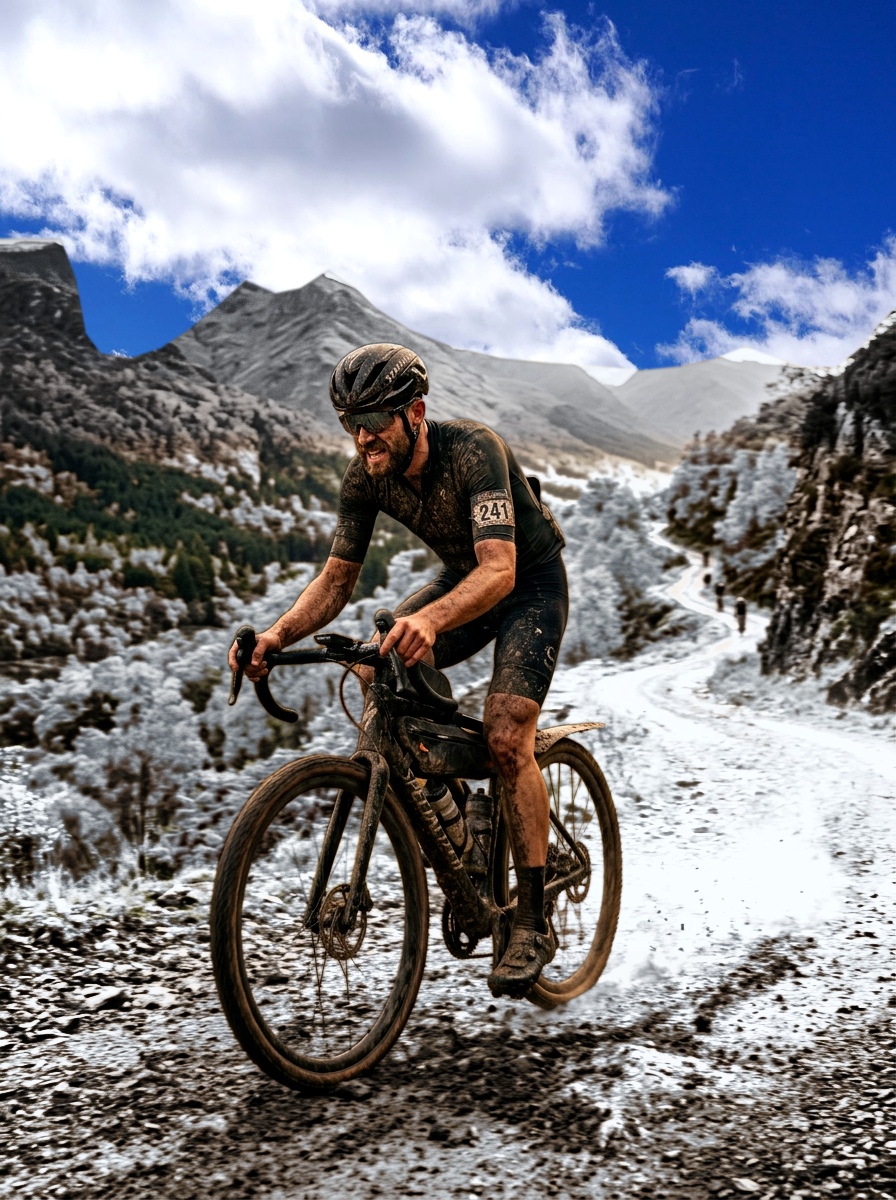
Rig Advisory: Minimum 50mm tires or 32" wheelset with generous frame clearance. 1x direct-mount transmission mandatory. Carry a paint stirring stick taped to your top tube for emergency mud scraping. Bobby Wintle hugs every single finisher at the arch.
104.2 MI
7,800 FT
FEBRUARY 2027
84% OFF-ROAD
The Threat: Billed as "not a race, but a wild escapade," the Cobbler defies every conventional cycling category. Course designer Sam Ames incorporates secret private ranch canyon paths, dry sandy arroyos, steep 22% cattle chutes, and surreal obstacle sections—including riding through backyard parties and carrying bikes up concrete stadium stairs.
Rig Advisory: 52T bailout climbing gear essential. Mountain bike tread profile recommended for loose dusty canyon descents. Aggressive dropper post proves invaluable on near-vertical drops.
103.8 MI
7,200 FT
FEBRUARY 2027
76% DIRT / WASH
The Threat: High-speed Sonoran Desert brutality. The route combines chunky hardpack fire roads, rocky desert singletrack, and deep sand washes that require sudden 400-watt out-of-the-saddle surges. Jumping jumping cholla cactus spines line the margins; straying off line results in instant multi-tire punctures.
Rig Advisory: Tubeless foam inserts mandatory to prevent rim destruction on submerged granite rocks. 45mm–48mm fast-rolling center tread with tall cornering lugs. Full sun exposure demands 3L hydration capacity.
115.0 MI
5,600 FT
MARCH 2027
95% RUGGED DIRT
The Threat: The raw wilderness of the Texas Panhandle Caprock Canyons. Red sandstone bluffs, abandoned rail-trail ballast sections, deep gypsum sand traps, and unrelenting 30 mph prairie crosswinds. Extreme isolation means mechanical failure leaves riders stranded miles from medical assistance.
Rig Advisory: 32" wheels excel in floating across the Caprock sand traps. Aero extension bars legal and advantageous against punishing Panhandle headwind sectors.
Expedition Recon • The Season Openers Continued
Foothill Grinds, Subtropical Swamps & Sandstone Ledges
89.6–100 MI
5,400 FT
MARCH 2027
70% GRAVEL / RD
The Course: A legendary fixture in Miguel Crawford's Northern California Grasshopper Adventure Series. Winding through the Sacramento Valley and into the remote foothills of the Mendocino National Forest. Fast-rolling hardpack gravel stretches through blossoming spring almond orchards before ascending into steep, remote dirt ridge climbs.
Tactical Recon: Lightning-fast early peloton drafting requires road race positioning savvy. 40–45mm tires provide optimal roll speed. Watch for slick stream crossings on foothill descents.
100.2 MI
650 FT
FEBRUARY 2027
88% CRUSHED SHELL
The Course: Florida's premier early-season flat gravel test. Traverses cattle dikes, water management levees, and crushed white coquina shell roads bordering the Everglades. Zero elevation relief means non-stop pedaling for 100 continuous miles with no coasting descents to rest your legs.
Tactical Recon: Relentless subtropical crosswinds create echelon racing. Aero cockpits and 2x or tight-ratio 1x gearing (44T x 10-44T) allow riders to maintain 24 mph pacelines across flat levee gravel.
102.5 MI
6,800 FT
MARCH 2027
82% DESERT ROCK
The Course: Set at the boundary of the Mojave Desert and the Colorado Plateau. Riders confront red sandstone ledges, loose volcanic gravel, and steep slickrock bench transitions. Cold morning canyon winds give way to intense desert radiation by midday.
Tactical Recon: 48mm tires with durable reinforced sidewalls. Low gearing for 15% sandstone stair steps. Ensure brake pads are fresh; 35 mph descents on loose sandstone eat organic pads quickly.
105.0 MI
5,200 FT
LATE FEB 2027
65% SUNKEN LOESS
The Course: The definitive Southern spring classic. Sunken unpaved roads carved through Mississippi River loess bluffs. Features thick gravel, rolling forestry clay, and short 18% wall climbs reminiscent of the Tour of Flanders.
Tactical Recon: Sudden transitions from cracked pavement to loose ballast gravel test bike handling. 42–45mm tubeless with supple casings provide optimal mixed-surface compliance.
Human Performance • Early Season Physiology
COLD-WEATHER DIRT DYNAMICS
Tackling a 100-mile unpaved century in February or March presents a physiological challenge distinct from summer racing: wide thermal swings, cold-induced dehydration, and impaired glycogen kinetics.
Words by Dr. Aris Thorne, Ph.D., Exercise Physiologist • Testing Data from University Human Performance Labs
The fundamental challenge of Q1 gravel centuries is thermal amplitude. At the 7:00 AM start line in Stillwater or Cave Creek, ambient temperatures frequently hover near freezing (30°F–36°F). By hour four, as riders crest exposed desert ridges or prairie rollers, intense solar radiation drives temperatures toward 68°F.
The Vasoconstriction Penalty: In cold morning temperatures, peripheral vasoconstriction diverts blood flow away from extremities toward the core. Beyond creating numb toes, this cold blood shunting decreases muscular contractile efficiency in the quadriceps by up to 11% at cadences above 90 RPM. Riders who surge over early climbs burn glycogen at an accelerated rate, setting themselves up for systemic failure by mile 65.
The Dehydration Trap: In sub-40°F air, sweat vaporizes almost instantaneously in dry headwinds, misleading riders into believing they are not losing moisture. Simultaneously, peripheral blood pooling triggers cold-induced diuresis, stimulating kidney filtration. Riders often arrive at mile 50 with a 3% to 4% plasma volume deficit, causing sudden electrolyte cramping during late-race climbs.
Layering Rule of 45 Degrees
Dress for the temperature expected 20 minutes into the ride at Zone 2 intensity. A windproof, breathable front-membrane vest (gilet) paired with lightweight merino arm warmers and convertible thermal gloves allows rapid thermal dumping as the sun climbs without stopping your bike.
Winter vs. Summer 100-Mile Energy Expenditure
| Physiological Metric |
Cold Q1 Century |
Hot Summer Century |
| Total Caloric Burn (6.5 hrs) |
5,400 kcal |
4,850 kcal (+thermoregulation) |
| Hourly Fluid Requirement |
550–700 ml |
850–1,100 ml |
| Carb Absorption Target |
90g / hour |
100–110g / hour |
| Core Temp Range |
36.8°C–38.1°C |
38.4°C–39.2°C |
| Blood Lactate Clearance |
Slower by 8% |
Baseline Optimal |
Zone 2 Conservation: When riding through early-season mud or loose gravel, mechanical drag spikes suddenly by 40% to 60%. The natural instinct is to stand on the pedals and power through at Threshold (Zone 4).
In cold temperatures, blood lactate clearance is noticeably sluggish. Every anaerobic spike into Zone 4 or 5 depletes non-renewable intra-muscular glycogen reserves. By remaining seated, dropping into your 52T bailout cog, and capping efforts at 75% of Functional Threshold Power (FTP), you preserve the oxidative fat-burning pathways required to conquer the final 30 miles.
Metabolic Fueling • Cold-Weather Mechanics
Fueling Below 40°F & Protecting Your Mechanical Systems
Standard sports nutrition guidelines assume temperate ambient conditions. When temperatures dip below 40°F, conventional fueling strategies collapse. Standard energy gels turn into viscous, unchewable paste that requires significant jaw effort to consume, while solid bars freeze into brick-like textures that can crack tooth enamel.
Semi-Liquid Formulation: For Q1 endurance, elite racers rely on high-concentration liquid carb bottles. Dissolving 90 grams of maltodextrin and fructose in a 1:0.8 ratio into 500ml of warm water with 600mg of sodium citrate delivers rapid gastric emptying without chewing.
Insulated Thermal Bottles: Standard plastic bidons exposed to 35 mph wind chills will freeze valve seals within 90 minutes. Double-wall vacuum-insulated stainless or polypropylene bottles prevent freezing and encourage continuous sipping.
The 90g Carb Blueprint (Per Hour)
- Minute 00–20: 250ml high-carb electrolyte drink (45g carbs, maltodextrin/fructose).
- Minute 20–40: 1 liquid hydrogel pack kept warm in inner jersey pocket (30g carbs).
- Minute 40–60: 2 soft chews or dates + 200ml plain electrolyte water (15g carbs).
- Hourly Total: 90g carbohydrate, 650mg sodium, 450–550ml fluid.
Cold-Weather Mechanical Countermeasures
Bicycles react to cold weather just like human muscles. Preparing your rig for early-season moisture and freezing gravel requires three essential mechanical modifications:
1. Low-Viscosity Freehub Lubrication: Standard heavy grease inside your rear hub’s ratchet drive or pawl system thickens significantly below 35°F. This prevents pawls from engaging, resulting in terrifying phantom pedal spins where the cranks spin forward with zero drive. Flush hub internals with isopropyl alcohol and lubricate exclusively with low-viscosity synthetic freehub oil (such as Dumonde Tech Freehub Oil).
2. Sub-Zero Tubeless Sealant: Natural latex sealants coagulate and freeze into useless solid balls below 32°F. Ensure your wheelsets are primed with synthetic glycol-based winter formulas (such as Orange Seal Subzero) rated down to -20°F.
3. Hydraulic Brake Seal Contraction: Extreme cold causes rubber quad-ring seals inside disc brake calipers to contract slightly, which can induce temporary micro-leaks or lever-fade. Bleed your mineral oil or DOT fluid systems within 7 days of event morning to eliminate moisture contamination.
Endurance Cartography • Official Partner Index
Planning your 2027 endurance calendar begins with North America’s premier verified 100-mile directory. Inside the official database of over 500 unpaved and mixed-surface centuries across 50 states.
Compiled in Partnership with CenturyRides.org Editorial Staff • Live Directory at CenturyRides.org
For decades, endurance cyclists planning their seasonal campaign relied on fragmented local club websites, word-of-mouth chatter, and unreliable registration portals. In 2024, our official editorial partner CenturyRides.org unified North American endurance cycling into a single verified registry.
Entering 2027, the directory catalogs over 500 sanctioned 100-mile events, with advanced sorting filters allowing riders to filter by:
- Surface Taxonomy: Filtering by percentage of unpaved dirt, gravel, singletrack, and asphalt connector sectors.
- Vertical Severity: Search by total elevation gain, from flat coastal levee grinds (<2,000 ft) to high-alpine crucibles exceeding 12,000 ft.
- Logistical Support: Distinguish fully supported rides with neutral feed stations from self-supported remote bikepacking centuries.
- Geographic Regions & Months: Plan your progressive seasonal ramp-up from Q1 southern classics to autumn Midwest epics.
"Our mission is simple," explains CenturyRides.org Director of Cartography Sarah Jenkins. "We vet every course profile with GPS telemetry to guarantee that when a rider registers for an unpaved century, they know exactly what tire width, gear ratio, and hydration capacity the terrain demands."
The Gravel Surface Classification Standard
Category 1 (Champagne Gravel): Fine, hard-packed limestone or crushed granite. Smooth as asphalt; 38–42mm fast tires ideal.
Category 2 (Washboard & Loose Dirt): Rhythmic corrugated ripples, loose marble gravel, and minor ruts; 45mm minimum tire width.
Category 3 (Chunky Ballast & Flint): Sharp railroad ballast, jagged flint, baby-head rocks, and deep sand pits; 48mm–50mm or 32" wheels required.
Category 4 (Unmaintained Technical Primitive): High-clearance jeep tracks, creek crossings, scree, and peanut butter mud; hike-a-bike probability high.
Access the complete, searchable database and route profiles for every state at CenturyRides.org/century-rides/.
Operations & Staging • Century Execution
The 48-Hour Unpaved Century Execution Protocol
T-Minus 48 Hours: Mechanical Staging
- Sealant Injection: Add fresh 60ml of synthetic winter tubeless sealant into each tire; inspect tread casing for embedded glass or thorns.
- Brake Caliper Inspection: Verify minimum 1.5mm pad thickness remaining; check hydraulic bite point.
- Battery Charging: 100% full charge on rear derailleur battery, spare battery in frame bag, head unit, heart rate strap, and radar unit.
- Torque Check: Inspect cockpit stem bolts, seatpost clamp, thru-axles, and pedal spindles with a calibrated torque wrench.
T-Minus 24 Hours: Metabolic Staging
- Glycogen Supercompensation: 8–10g carbohydrate per kilogram bodyweight. Focus on low-fiber starches (white rice, potatoes, sourdough, maple syrup).
- Sodium Pre-Loading: 1,500mg sodium in evening electrolyte beverage to expand plasma volume before race day dehydration.
- Route Telemetry Download: Download offline vector base maps and route GPX files to primary head unit and mobile phone backup.
Race Morning: T-Minus 120 Minutes
- Breakfast Protocol: 120g carbohydrates 2.5 hours prior to roll-out (oatmeal with honey, banana, espresso).
- Ambient Temperature Pressure Calibration: Calibrate tire pressure outdoors at actual morning ambient air temperature. Tires pumped in warm hotel rooms lose 2 PSI when brought into freezing outdoor air.
- Hydration Staging: Mount two warm insulated carb bottles (90g each); pack frame bladder with plain water.
- Emergency Gear Verification: Confirm presence of Dynaplug darts, mini pump, chain master links, tire boot, and emergency foil blanket.
Navigation Redundancy Rule
Never rely on a single GPS device in remote canyon terrain. When battery cold-drain or tree canopy blocks signals, carry a laminated top-tube cue sheet noting mile markers for water stops, major turns, and bailout roads.
Voices of the Frontier • Dispatch
THE DIRT DISPATCH
Dispatches from the riders, race directors, photographers, and grassroots clubs defining the soul of 100-mile unpaved cycling.
Edited by Julian Vance • Community Submissions to gravelcentury.com/vol2
"Why We Hug Every Finisher"
By Bobby Wintle • The Mid South
"When someone crosses that finish line arch on Main Street in Stillwater at hour eight or hour eleven, covered head to toe in crimson dirt, they are not the same human being who rolled out at 8:00 AM. They conquered self-doubt, mechanical disasters, and freezing headwind gusts. That hug isn't ceremonial. It is an acknowledgment that they surrendered everything they had to the red dirt road and found something deeper inside themselves."
The Girona Lens
By Julian Vance • Senior Photographer
"Standing trackside at Sea Otter Europe on the final limestone descent, watching the 32-inch prototypes blast down the rock garden was surreal. Where traditional 700c bikes skipped and chattered sideways, the big wheels traced a clean, velvet arc through the dust. The sound was different too—less violent metallic rim chatter, more of a deep, resonant turbine hum. You knew instantly you were staring into cycling’s future."
Grassroots Rising
By Maya Lin • Ozark Gravel Collective
"The magic of gravel is that it doesn’t belong to federations or corporate brands. In Northwest Arkansas and Southern Missouri, our weekend century rides start behind a grain elevator with forty riders, two thermoses of coffee, and a shared GPX route. No timing chips, no podium ceremonies. Just a pact to watch each other’s backs across 100 miles of loose Ozark chert."
Join the 2027 Century Challenge
Complete three verified 100-mile unpaved centuries in 2027 and submit your telemetry to Gravel Century Magazine and CenturyRides.org to earn the official 2027 Dirt Finisher Credential.
GRAVELCENTURY.COM/VOL2
GRAVEL CENTURY MAGAZINE • VOLUME 2
ISSUE ARCHIVE: Q1 2027
The Unpaved Creed
"One hundred miles of unpaved dirt does not test what bike you bought;
it tests what spirit you brought."
Past the pavement, beyond the cellular signal, where the horizon bends and the gravel hums beneath wide rubber. That is where endurance lives.
500+ CENTURIES
Indexed on CenturyRides.org
32-INCH WHEELS
ISO 686 Standard
100G CARBS / HR
Endurance Fueling
100% UNPAVED
Radical Self-Reliance
GRAVEL CENTURY MEDIA GROUP
Editorial partner:
CenturyRides.org
Published quarterly at gravelcentury.com
GRAVELCENTURY.COM/VOL2
ISSN 2831-9042 • VOL. 8 NO. 1